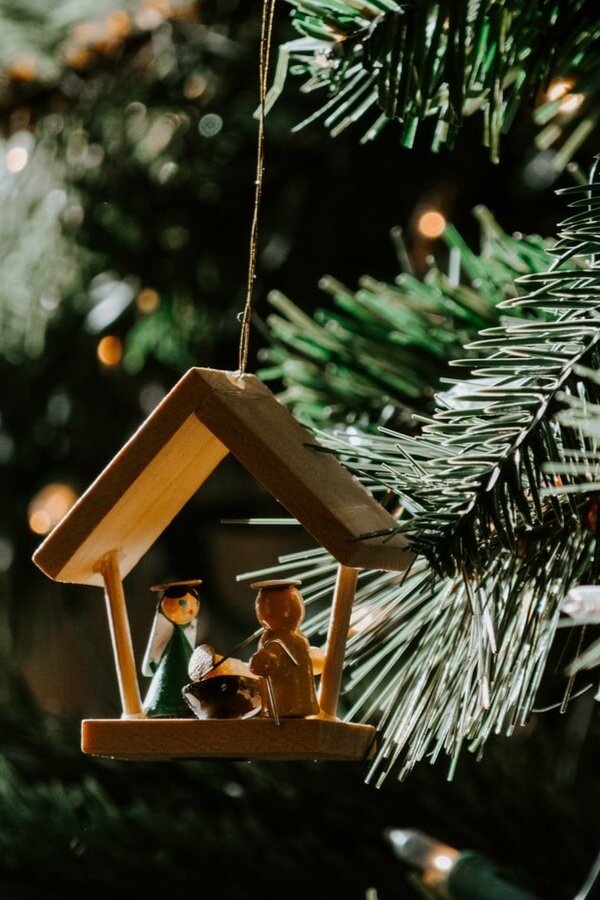
Everyone knows it is bad luck to leave one’s Christmas tree up beyond Twelfth Night. Which is unfortunate, as we finally got around to removing ours yesterday.
From what I’ve been able to discern, the upshot of this transgression could either be short- to mid-term damage to our vegetation and greenery, or the guarantee that 2021 will be worse than 2020. Frankly, the latter seems the more implausible of the two.
But what do we really mean by ‘taking the tree down’? Do we mean the tree itself, or just the decorations? After all, unless physically felled, a tree is, by its very nature, ‘up’.
For the sake of clarification then, we removed the festive ornaments and trimmings from our Christmas Tree on January 2nd, but we neglected to remove the tree itself, leaving me unsure as to whether we have actually breached this ominous deadline or not.
According to one of the leading authorities on such matters, WalesOnline, the practice of taking down the tree dates back to Pagan times, when people believed that there were tree spirits living in the decorative holly and ivy used to commemorate the Winter Solstice. These spirits had to be released promptly, post-celebration, to give them time to find a leafy new home, or horticultural catastrophe would ensue.
Based on this belief system, there can be little doubt that we are guilty. We have kept our tree spirits cooped up far longer than necessary and our garden will presumably suffer the consequences in the year ahead. Yet it strikes me that this is not a question of luck, but of poor decision-making. We screwed up, basically.
Matters do not become any clearer once Jesus is on the scene.
In the Christian tradition, it is bad luck to leave one’s Christmas tree up beyond Twelfth Night, because Twelfth Night signifies the end of Christmas, the following day (January 6th) being the Epiphany – also known as Three Kings’ Day – which marks the arrival of the Three Kings in Bethlehem after a lengthy journey in pursuit of a star. But it also commemorates the baptism of Christ by John the Baptist several decades later, an event that, from what I can gather, took place on the same date. Neither event appears to have anything directly to do with trees.
There is also something of a dispute over whether Twelfth Night itself should fall on January 6th, but it’s hard to see this as anything other than a counting error, given that the first day of Christmas is plainly December 25th (or December 24th if you’re from Argentina, Austria, Brazil, Colombia, the Czech Republic, Denmark, Estonia, the Faroe Islands, Finland, France, Germany, Hungary, Iceland, Latvia, Lithuania, Luxembourg, Norway, Poland, Portugal, French Canada, Romania, Uruguay, Slovakia, Slovenia, Sweden or Switzerland).
Of course, if you’re a Roman Catholic (and there are 123 million of them in Brazil alone), you may well choose to ignore both dates and leave your tree up until February 2nd, the festival of Candlemas. Candlemas commemorates the presentation of Jesus by Mary at the Temple, part of a post-childbirth purification ritual stemming from the time of Moses which is first referenced in Leviticus, the most contemptible text in the Bible and a strong contender for Worst Book Ever. Intriguingly, this tradition involved the sacrifice of two turtle-doves, creatures that – several thousand years later – would be gifted to a young lover on the second day of a peculiar courting ritual popularised in an 18th Century Christmas carol, The Twelve Days of Christmas, which not only restores the link to Twelfth Night but reintroduces a tree to proceedings, this time complete with live game.
And as we fall further down the rabbit hole, it seems entirely justifiable to suggest that the real bad luck is exacted not upon those who fail to take down their Christmas trees within the period officially designated by their belief system, but upon those who have the misfortune to stumble upon this blog.
Photo by Kelly Sikkema on Unsplash.

 Pop Life