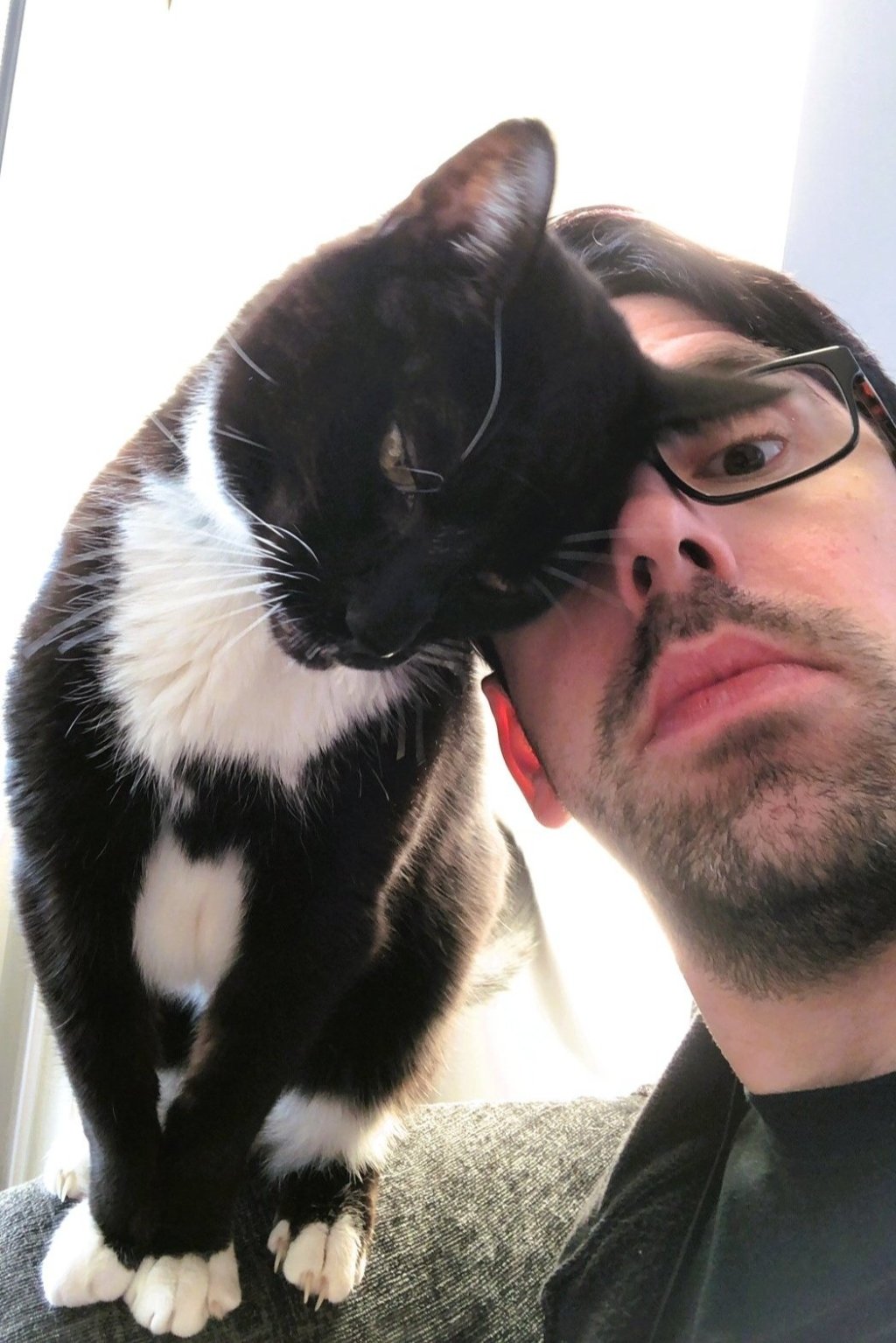
Yesterday it dawned on my friend that his cats are mortal and, due to their inbreeding, they are rapidly approaching their average life expectancy.
One might speculate as to why this realisation hadn’t been reached earlier, but regardless, I was on hand to reassure him that, by the time of their demise, he’d be ready for it – indeed, he might even think it ‘for the best’.
My own long-in-the-tooth feline, Mr. Kitten, serves up a daily reminder about the perils and pitfalls of ageing. He’s not quite a wreck of a cat, but he’s headed in that direction. Food, partially chewed, goes everywhere. So does the litter. I’ve had to switch brand to a clumping litter that turns to solid clay when wet, so sick am I of being covered in urine-soaked globules every time he sits on me. Which is now 100% of the time, and irrespective of whether I already have the baby in my arms.
What else? Well, there’s a furball-infused mess deposited on the carpet at least four times a week. He has also developed a blackly comedic tendency to vomit shortly after defecating, which I put down to his alarm at the terrifying stench following him out of the litter tray. The smell would be largely obscured if he’d only cover up his mess, yet such behaviour has lately fallen out of his repertoire. It seems you can’t teach an old cat old tricks.
In many ways, tending to Mr Kitten mirrors the challenges we face when looking after the elderly, once body and mind begin to fail. Despite our best intentions as humans, our desire to care for our elders almost always ends up supplanted by a sense of obligation, which in turn breeds resentment at the sheer number of care-related commitments we are eventually obliged to meet. Of course, in most cases, all trace of bitterness vanishes once the helpless elder keels over. Then we can focus on preserving the memory of them in their glory days, fully compos mentis and not yet too far down infirmity street.
It’s a strange thing to contemplate, speaking as a person who has always struggled to come to terms with their mortality, but I’m starting to wonder whether it might in fact be evolutionarily advantageous for people’s bodies and minds to turn to garbage before they kick the bucket. As people (or indeed, animals) become more helpless, they’re forced to turn to their loved ones to support them, often beyond a level that’s reasonable or sustainable. By the time they die, we’re ready; indeed, in our darkest moments, we might even wish them on their way.
Science is not my strong suit, and I confess that substantial sections of The Selfish Gene went over my head, so what I’m positing may have no evolutionary significance whatsoever. But it strikes me that this transition from loved one to carer – and all of the dispassionate decision-making that the role demands – is quite handy, given that death is, at the time of writing, unavoidable.
By assuming the role of carer, we begin to prepare ourselves for the inevitable, and thus become insulated against the unbearable grief and potential for permanent psychological damage that can stem from a sudden, unexpected loss, when a person (or cat) is taken from us too early.

 Pop Life