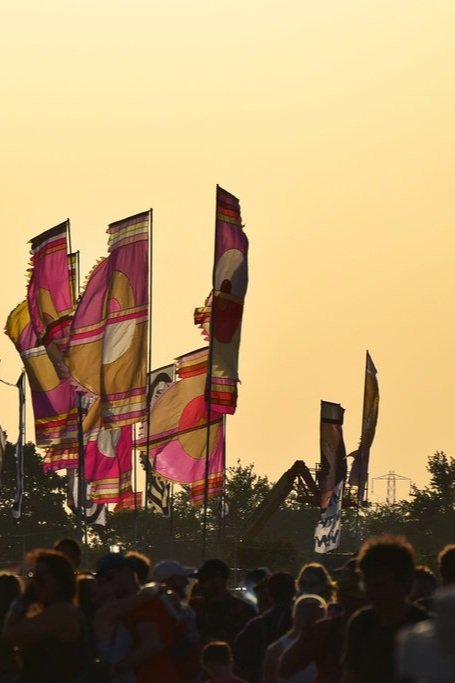
It’s better watching Glastonbury on TV. People don’t realise this until they go there and experience it for themselves. You arrive at the main stage and find that it’s nigh on impossible to see anything as a result of all the giant flags proudly being displayed by the idiots at the front of the crowd.
I don’t know when the flag trend took off. When you watch clips of Glastonbury from the 90s, there certainly don’t appear to be as many around. Of course, a lone flag at a festival is incredibly helpful. The flag owner is instantly locatable to their friends. Those nearby the flag owner are also able to cite the flag as a reference point. This value is lost, however, when there are 4,000+ flags on display. At this point, everyone is forced to watch the show via the screens.
Flags are less of a problem on the other stages, but then there’s the issue that Glastonbury is far too big. The distances between stages are greater than any other festival I’ve been to, and you’re unable to move at pace from one stage to the next because a) there are too many people, b) it’s too muddy, c) you’re wearing wellies, and d) your friends are cretins and have been distracted by a relaxation tent.
On my two visits to Glastonbury, I’ve arrived with a carefully planned itinerary and, on both occasions, the itinerary has been abandoned on the realisation that it is simply not possible to circumnavigate the site in a prompt and orderly fashion.
In contrast, it seems that absolutely every performance is now available, live or on-demand, on iPlayer. It’s the ideal Glastonbury experience, made all the more perfect by the fact that, unless you live in rural Somerset, you won’t risk coming into contact with any of the other Glastonbury-goers.
This might sound a little harsh. In truth, my beef with Glastonbury is not so much with the attendees, but with the fact that it masquerades as a music festival when every facet of its construction and curation appears designed to inconvenience music fans.
Like the European Research Group, Glastonbury tries to have its cake and eat it. It badges itself online as a performing arts festival yet leans near-exclusively into its musical line-up to promote itself, as plainly no one in their right mind would travel halfway across the country to a remote farm near Pilton for a performing arts festival. It secures the biggest musical acts in the world, and then it encourages attendees to entirely obscure them from view. Perhaps the most iconic music festival in the world, Glastonbury is basically great at everything except music.
Or perhaps I’m just jealous that I’m not there.


 Pop Life