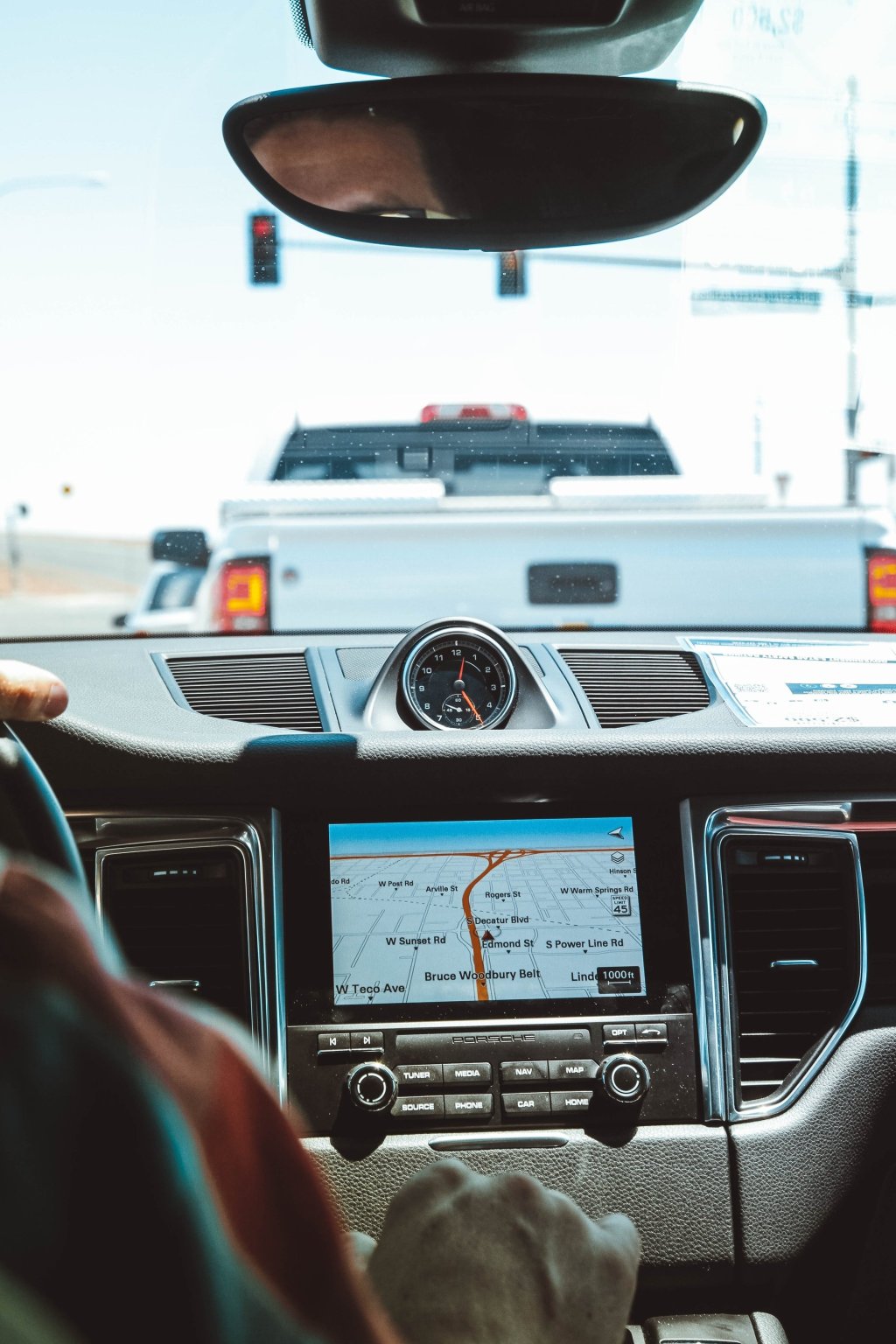
There’s an episode of the US Office in which Dunder Mifflin office manager Michael Scott, acting on the instructions of his new SatNav, drives his rental car into a lake.
It’s a good joke, and the SatNav has been the butt of many a similar gag over the past two decades. Of course, at the heart of every good joke is a kernel of truth. Regardless of how often SatNavs get things right when navigating complex transport infrastructure, we still expect them to go spectacularly wrong at some point, hence why they retain their comedic capacity. This might also explain why it’s difficult to find a good gag about mechanical systems failure on aircraft.
Yesterday, when preparing to exit the M3 and join the M25 on the way to Heathrow Terminal 5, my SatNav told me to keep right, despite every sign for Heathrow indicating that I needed to be in the left-hand lane. As a relatively new driver, and until very recently an M3 virgin (an underwhelming congress), this put me in a bind. To trust my instincts and years of generally sound navigational ability, or to trust the technology? I put my trust in SatNav and, sure enough, within 60 seconds I found myself heading counter-clockwise towards Gatwick.
This got me thinking about artificial intelligence. Clearly my SatNav has been developed by idiots and one can only hope that the satellites on which it relies are soon destroyed by space debris, or the Chinese, so that I’m forced to revert to my good judgement as a way of getting around. But there are other, better, smarter SatNavs out there. And as more and more $ billions are poured into AI development, technology is going to become smarter than we are, to the extent that it will almost certainly outperform us in this type of decision-making – regardless of what our instincts tell us.
So, the question on my mind, is how will we know when it’s okay to put our complete faith in these technologies? To have total confidence that if the system says keep right, and our intuition (or indeed, the roadside signage) says turn left, we should under no circumstances trust ourselves?
Maybe it will be obvious. Maybe Big Tech will declare a Global Day of Celebration and Rejoicing to alert us to the good news: that we can now trust technology to do things consistently better for us than we can do ourselves. Yet even at this point, it’s easy to foresee high levels of residual suspicion persisting amongst, we, the supplanted human intelligentsia. Distrust of the technology itself or, just as likely, of the technology’s authors.
Then there’s the still more frightening prospect of technology that is far superior to anything human developers could conceive of, because it has been conceived by ultra-intelligent machines. Would you trust a SatNav designed and built by a sentient AI?
It puts me in mind of the supercomputer in the Hitchhiker’s Guide to the Galaxy, Deep Thought, which calculated the answer to the Ultimate Question of Life, the Universe, and Everything, but was unable to determine calculate the Ultimate Question itself. To pacify its unhappy masters, Deep Thought designed a supercomputer of its own to solve the problem – a supercomputer so large it was often mistaken for a planet. The supercomputer was the Earth, and it was destroyed just five minutes before it could answer the Ultimate Question to make way for a hyperspace bypass.
All of which brings us neatly back to the subject of navigating complex transport infrastructure, and the suspicion that, lurking somewhere within the text, there is the kernel of a moral.
Photo by John Schnobrich on Unsplash


 Pop Life