Listen up
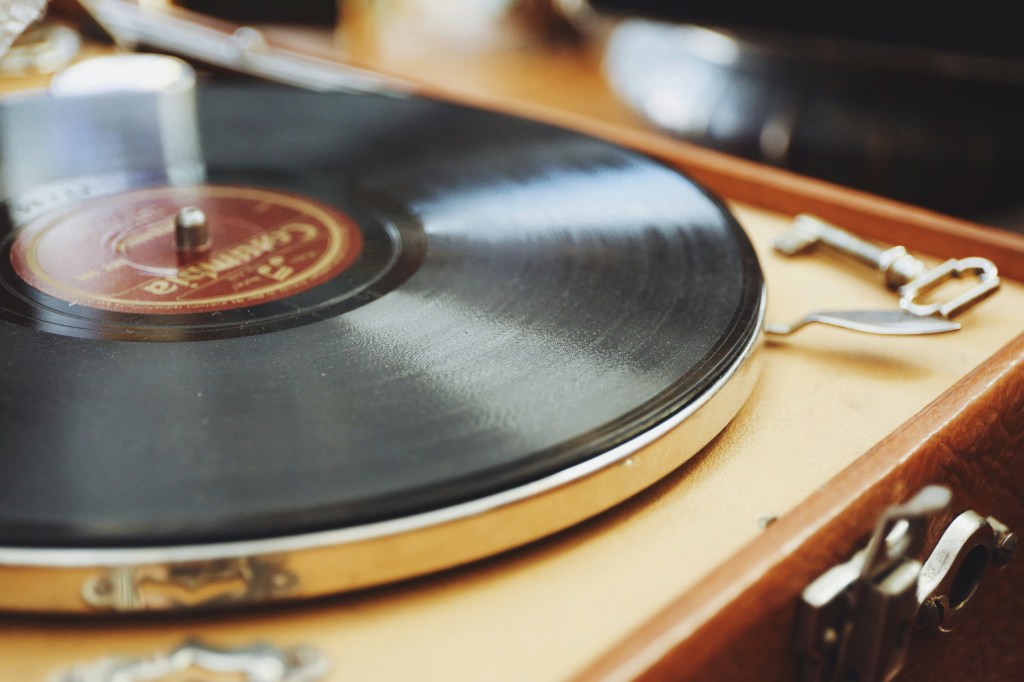
My friend Rick just bought a record player, which meant I had to have one too.
He turned up at my house two months ago and announced it, casually, as if it was the sort of thing I really ought to have guessed. Rick’s expensive impulse purchases are the stuff of legend; however, having spent much of the past decade locked in a Spotify doom loop, listening to the same playlist on repeat, the news that he had randomly fallen back in love with music caught me by surprise.
Of course, what Rick didn’t know was that I was already contemplating a similar move. Laura’s dad had offered us his old record player, and I was umming and ahhing over whether to accept it, and seal my fate down the inevitable vinyl rabbit hole.
A week later, sat on Rick’s sofa, and five seconds into Side A of Rumours, the decision made itself.
Now, records are not cheap. For the record industry, they have become something of a cash cow. And so, having made my decision, thoughts quickly turned to what exactly I might want to buy.
The problem is that, even after a ruthless clear-out earlier in the year, I still own somewhere between 1,200 and 1,400 CDs. This is, effectively, the streamlined collection; attempting to recreate it on vinyl would be an act of financial lunacy. The sort of thing Rick would do.
So instead, I dug out the list of my all-time top 20 albums to serve as a constraint system. The idea was that by limiting myself to my personal classics, I’d keep a lid on my spending and build a small, elegant and painstakingly considered record collection that I’d be proud to show off to any future house guest.
A brilliant conceit in principle; in practice, however, there were a few immediate problems – and that’s ignoring the fact that the average age of our house guests is three. Firstly, my all-time top 20 albums list currently contains 54 entries. Secondly, on my very first trip to the nearest record store, I emerged with three records that weren’t on the list.
It has been a very expensive few months. But although my system plainly wasn’t watertight, it did shape my thinking, and it prevented the two extremes of decision paralysis or, more likely, my buying every record on the planet.
And this is what’s so interesting about constraint systems: we need them in our lives. Without them to guide us, it becomes difficult to decide anything at all.
The very act of listening is a constraint system. Time is another. Yes, you have access to over 100 million songs courtesy of your streaming provider. But to hear them all would take over 500 years of round-the-clock listening, and to attempt to listen to them all at once would be extremely misguided.
Of course, there’s a big difference between constraints that force you to choose between competing preferences and constraints that try to impose them. In my first book, Pop Life, I set myself the challenge of going to a gig a week for a year. Several friends asked me if that was ‘a thing’, by which I assumed they meant an emerging social media trend, like planking or McDiving. It wasn’t – I had invented a new rule simply because it seemed like the best way to keep me alive at the time.
The constraint worked because it wasn’t prescriptive about what I saw. It only demanded that I keep showing up. Taste still did the work, although, admittedly, someone forced me to see Pete Doherty one week, which was a useful reminder that constraints don’t save you from criminally poor choices.
By contrast, Laura once decided to work her way through 1001 Films You Must See Before You Die. It started as a useful exercise in guided discovery, granting her permission to watch things she’d never normally choose. Then it became over-prescriptive, and she began to get annoyed with me for wanting to watch films that weren’t on the list.
I’ve also met people who’ve tried to watch every Best Picture winner at the Oscars. I’ve never met anyone who’s finished. This is because the Best Picture category is not a genre, and some of the winners are truly shit. I’m looking at you, Crash.
Constraints should encourage judgment, rather than replacing it. Lists fail when they turn curation into obedience, and algorithms do us a disservice for the same reason.
In many ways, the appeal of vinyl isn’t nostalgia, but the reintroduction of friction to my music listening. The record player is forcing me to decide whether I prefer Garbage’s self-titled debut to Version 2.0 (I do, though the latter includes Push It, which would sound fantastic through my new speakers). It’s making me question whether it’s worth paying £450 to ship a copy of My Vitriol’s long-out-of-print Finelines over from Japan.
The right constraint system should ask all the right questions, even when it leads to hilariously predictable answers. No, of course, it’s not worth paying £450 for Finelines… But there’s a fair chance that I’ll do it anyway.
Photo by Pierre Gui on Unsplash





 Pop Life
Leave a comment